
When I rewatched the first season of Slow Horses, I found an even more sophisticated series than I remembered. Not only because some of its most recent revelations had been carefully planted from the very beginning, but because Jackson Lamb’s most interesting relationship may not be with River Cartwright, or even with his adversary and intellectual equal, Diana Taverner. It is with Catherine Standish, the woman he protects, mistreats, provokes, and continues to lie to.
There is no romance between them, at least not in the conventional sense. What exists is more complicated: guilt, complicity, respect, a debt that may never be repaid, and the possibility that, by saving Catherine, Lamb is trying to save another woman who died in front of him many years ago.
This article contains spoilers from every season of Slow Horses released so far, as well as from Mick Herron’s books.

Diana Taverner Always Knew
In the fifth season, Gary Oldman delivers what may be the most impressive monologue in the entire series. Surrounded by MI5 agents, Lamb begins telling the story of a spy captured by the Stasi in Berlin. The man had the soles of his feet burned and was forced to remain standing for days while his torturers tried to extract a name from him.
When they realize that he will not break, they find his only weakness. They bring in the woman he had been involved with and begin torturing her in front of him. She says she is pregnant. He begs them to stop, but still refuses to give them the name. The woman and the baby die, until the Stasi finally understands that he withheld the information because he never actually knew the answer.
The sequence is brilliant because it works on several different levels. While Lamb appears to be distracting the agents with a horrifying story, he is feeding coded instructions to the slow horses, who understand the clues and manage to free themselves. What we only discover later is that he was also telling his own story.
At the end of the season, the camera shows the burned sole of his foot through a torn sock. The tortured agent was Jackson Lamb. The woman murdered in front of him was someone for whom he had felt the closest thing a spy might call love. Lamb may also have lost a child in that room.
The revelation is recent, but the information was not invented for this season. In the first season, Diana warns an agent not to underestimate Lamb. She acknowledges that he is odious, but reminds him that Lamb was tortured and did not break. Diana, therefore, always knew.
She also knew the truth about Charles Partner, the former Director General of MI5 who was working for the Russians. She knew that David Cartwright had ordered his execution and that Lamb had pulled the trigger. More importantly, Diana knew that Catherine was unaware of all of it. From the beginning, she uses the truth as leverage against Lamb and immediately recognizes that threatening Catherine provokes a different reaction in him.
Diana Taverner knows Jackson Lamb’s file. Catherine Standish knows Jackson Lamb. Those are not the same thing.

Catherine Hears the Story Hidden Inside the Story
After the monologue, Catherine is the only person who asks whether the tortured spy was Lamb. Everyone else understands the escape strategy. She recognizes the emotion hidden inside the code.
Lamb lies and says the story was not true. Later, the camera gives the audience the proof he refuses to give Catherine. We see the scar. She does not.
Even so, Catherine probably knows that he lied. The monologue contained too many details and, above all, too much pain. She recognizes the moment when something breaks through the armor of this seemingly unfeeling man. She may not know every fact, but she understands that while everyone else was listening to a spy story, Lamb was talking about himself.
This makes their relationship even more fascinating. Catherine comes closer than anyone else to the truth about Lamb, but he continues to prevent her from reaching it completely. It happened with Charles Partner, it happens with the torture, and it will happen whenever she asks a question capable of penetrating the wall of hostility.
Lamb can endure physical pain, humiliation, and interrogation without revealing a name. What he cannot do is voluntarily give someone his own truth.
The Ghost of Charles Partner
In Mick Herron’s books, Charles Partner was Catherine’s former boss and one of the most powerful men at MI5. She admired him deeply and believed he had protected her during the worst period of her alcoholism. In reality, Partner was a Russian mole who had been using her addiction to cover his own tracks.
He was planting documents and evidence that could make Catherine appear responsible for the leaks. If his betrayal were uncovered, she would be sacrificed in his place. The woman who believed Partner had saved her was actually his emergency exit.
David Cartwright discovered the betrayal, kept Partner operational for a while to feed false intelligence to the Russians, and then ordered Lamb to kill him. The execution was presented as a suicide. For years, Catherine believed Partner had taken his own life and that Lamb had merely given him the gun.
Lamb, therefore, carried three truths she did not know: he had killed the man Catherine admired, Partner was a traitor, and he had been willing to destroy her to protect himself.
That is where part of Lamb’s moral debt comes from. He does not appear to regret executing a Russian mole. His guilt lies elsewhere: in how Catherine was used, in the lie that preserved her memory of Partner, and in the fact that he once again decided which truths she was capable of enduring.
By bringing her to Slough House, Lamb gives her work, structure and a reason to remain sober. He does not treat her as a useless alcoholic, although he never stops provoking her about drinking. He recognizes her competence and knows that beneath the discreet appearance of a secretary is an exceptional agent.
Catherine watches, listens, remembers, detects inconsistencies, and knows how to move through a room without drawing attention to herself. She solves problems the others fail even to notice and withstands pressures that cause supposedly better-prepared agents to unravel. Her strength does not lie in violence or in the need to prove that she belongs at MI5. It lies in her ability to remain alert and not break.
Perhaps Lamb respects her precisely because he recognizes in Catherine the quality by which he himself is defined. Catherine does not break either.

Why Does Lamb Tempt Catherine With Alcohol?
It is one of the most troubling contradictions in their relationship. If Lamb genuinely wants to protect her, why is he rude, leaves alcohol within her reach, and provokes her about her greatest vulnerability?
One explanation lies in the brutal logic through which he learned to survive. To Lamb, protecting someone does not mean sparing that person, but preparing them for what the enemy will do. If a vulnerability exists, it will be found and exploited. By placing Catherine in front of alcohol, he tests her resistance in an environment he believes he can control. His twisted reasoning seems to be that if she can resist him, she can resist anyone else.
That does not make his behavior any less cruel. Trauma does not automatically transform violence into care, and Slow Horses does not ask us to forgive Lamb for everything simply because he suffered. Some of his aggression is method, some of it is self-defense, and some of it is simply cruelty. He has lost the ability to distinguish protection entirely from aggression.
There is also a difference between helping Catherine and allowing her to turn him into her savior. Partner once occupied that position in her life. She believed she owed her recovery to the man who was secretly using her. If Lamb presented himself as kind, nurturing, and openly protective, he could become another object of idealization.
He helps her while sabotaging any possibility of being seen as a hero. He wants Catherine to sustain her sobriety without attributing it to him. It is a perverse form of care, but consistent with a man who seems determined to prevent anyone from becoming emotionally dependent on him.
The more Lamb cares, the more he needs to hide the feeling beneath an insult. His hostility prevents intimacy, gratitude, and any conversation about why he always appears in person whenever Catherine is in danger.
The Woman Lamb Could Not Save
This is where a theory emerges that the series has not yet confirmed, but which makes increasing sense. The woman tortured by the Stasi was pregnant and died in front of Lamb while he remained immobilized. Rationally, he could not save her and did not possess the name his torturers demanded. Psychologically, however, he may have spent the rest of his life carrying survivor’s guilt and the impossible fantasy that he should have done something.
Catherine is also a woman destroyed by the world of espionage and used by a man she trusted. She is not a replacement for Lamb’s lost love, and their connection does not need to be turned into romantic passion. The projection may lie precisely in the possibility of reparation.
Lamb could not save the woman from his past, but he can stop Catherine from being sacrificed by the same institution. He could not intervene while the Stasi tortured the woman in front of him, but he no longer remains still when Catherine is in danger.

That is why, when she is kidnapped in Real Tigers, he goes to rescue her himself. Lamb saves his agents even though he spends his days trying to convince them that they are disposable, but with Catherine there is something that predates Slough House. He feels responsible for her.
Perhaps every rescue is an unconscious attempt to rewrite the original scene. This time, he arrives. This time, he gets the woman out of the room. This time, she survives.
It also helps explain why Diana uses Catherine against him. Diana knows about the torture, the dead woman, Charles Partner, and the execution ordered by David Cartwright. She knows that Catherine is one of the very few points through which Lamb can be wounded.
The threat to reveal the truth about Partner was not merely about exposing a covert operation. It meant destroying Catherine by revealing that the man to whom she attributed her salvation was a traitor and that the man she now trusted had been his executioner. Diana was simultaneously threatening Catherine, the bond between them, and the narrative that had allowed her to survive.
The Lie That Protects Also Wounds
At the end of the third season, Lamb finally reveals that Partner was a mole and had intended to frame Catherine. The truth destroys the memory that had sustained part of her recovery, and she leaves Slough House.
Her departure matters because Lamb repeats Partner’s behavior, even if their intentions are different. Both men conceal information and decide which truths Catherine should or should not know. Partner lies to manipulate and sacrifice her; Lamb lies because he believes he is protecting her. The moral difference is enormous, but her autonomy is still taken away.
In the fourth season, Catherine returns to help River and protect David Cartwright. By the fifth, she is once again part of Slough House’s orbit, following Shirley and helping Lamb capture Tara. The series does not offer a grand reconciliation, perhaps because a sentimental conversation between the two would betray the characters. Catherine simply returns.
She comes back after discovering who Partner really was and what Lamb had concealed from her. She no longer needs to idealize either man. For the first time, she chooses to remain beside Lamb while also knowing about his lies.
She simply does not know all of them. She still does not officially know that he was the agent tortured by the Stasi, that a woman died in front of him, and that he may have lost a child in that room. She recognizes the truth, asks him about it, and receives another lie.
That is Lamb’s limit. He can save Catherine from the world, but he does not know how to protect her from himself. He can place his body between her and danger, but he cannot build intimacy without secrets. Catherine is the person before whom he runs the greatest risk of becoming decipherable, so he draws her close, pushes her away, protects her, provokes her and, whenever she comes too close, lies.
Perhaps she does not need a confession. Catherine asked whether the story was about Lamb because, on some level, she already knew the answer.
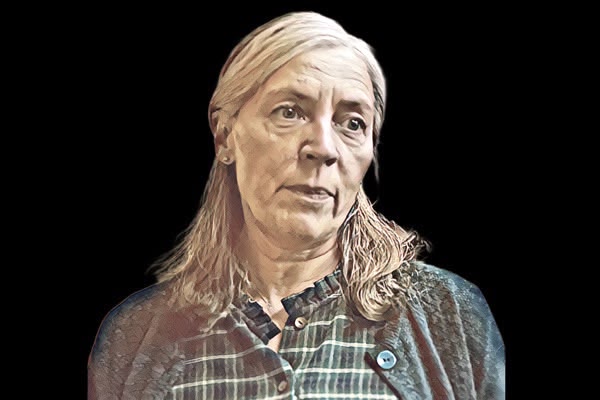

Saskia Reeves, Long Before Catherine Standish
And yes, your memory of Saskia Reeves is almost correct, just displaced by a few years. The period film you are probably remembering is December Bride. Produced in 1990 and released in 1991, the drama takes place within a rural Presbyterian community in early 20th-century Ireland. Reeves plays Sarah Gilmartin, an independent woman who scandalizes the local community by becoming involved with two brothers, played by Donal McCann and Ciarán Hinds. The film received the Special Jury Prize at the European Film Awards.
She also made her mark on British cinema in 1991 with Close My Eyes, opposite Alan Rickman and a young Clive Owen. It was not a period film, but a highly provocative contemporary drama about an incestuous relationship between two siblings. The film won the Evening Standard award for Best British Film and became one of her best-remembered works. Reeves and Clive Owen would work together again more than three decades later.
That history makes her Catherine even more interesting. Saskia Reeves understands discreet, resilient, and emotionally complex women. Opposite the explosive nature of Gary Oldman’s performance, she works almost in silence. Catherine watches Lamb as no one else does, notices what he conceals, and understands the story behind every lie.
Jackson Lamb always arrives to save her because he has spent his life haunted by the woman he could not save. Catherine, in turn, may be the only person capable of saving him, not because she can change who he is, but because she keeps coming back even after seeing what lies beneath the filth, the hostility, and the secrets.
Descubra mais sobre
Assine para receber nossas notícias mais recentes por e-mail.


1 comentário Adicione o seu