
Fifty years ago, Brian De Palma did something particularly cruel to Carrie White: before destroying her, he let her be happy. For a few minutes during the prom sequence in Carrie, released in 1976, the girl who had spent her life being humiliated by her mother and her classmates dances with Tommy Ross, smiles, relaxes, and perhaps believes for the first time that there may be a place for her in the world. We know there is a bucket of blood hanging over her head. She does not. And that is exactly why, half a century later, the scene is still almost unbearable to watch.
Popular culture turned Carrie into the girl covered in blood, staring wide-eyed as the gym burns around her, but that is not really the secret of the film. If Carrie were simply an angry teenager who discovers powers and decides to get revenge, Brian De Palma would have made an efficient horror movie. What he created was a tragedy. First we meet a girl who does not even know what menstruation means, who lives in terror of a religiously fanatical mother and who has learned at school that any difference can turn her into a target. Then, for a few minutes, the film allows us to believe with her that escape might be possible. That is the hope the bucket destroys.
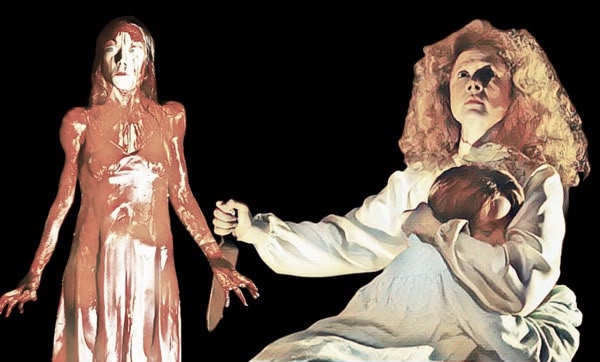
And perhaps that is why, after a sequel, other adaptations, a musical, a cinematic remake and now a Mike Flanagan series, no one has truly replaced the 1976 version. When we think of Carrie White, we still see Sissy Spacek.
From a first novel to a movie classic
When Carrie reached Brian De Palma, Stephen King was far from being the writer who today practically constitutes a genre all by himself. The novel, published in 1974, was his first book to appear in print, and De Palma later said he heard about it through a writer friend. He liked it, found out the rights had not yet been sold, and began pursuing the project. After passing through 20th Century Fox, the adaptation eventually landed at United Artists, which pushed for De Palma to direct.
It was a particularly fortunate match because De Palma had no reverence for the book. He understood something that still separates memorable adaptations from merely correct ones: fidelity does not mean transcription.
King’s novel is structured as the reconstruction of a catastrophe. The narrative is interrupted by testimonies, investigations, books, documents, and studies of telekinesis. Early on, we know something terrible happened, and we watch a society trying to explain, after the fact, something it helped create. The first screenplay retained part of that material, but De Palma and screenwriter Lawrence D. Cohen abandoned it. They also drastically reduced the scale of the destruction. In the novel, after the prom, Carrie practically devastates Chamberlain; in the film, the tragedy is concentrated at the school, on the road and, finally, inside the suffocating house she shares with Margaret.
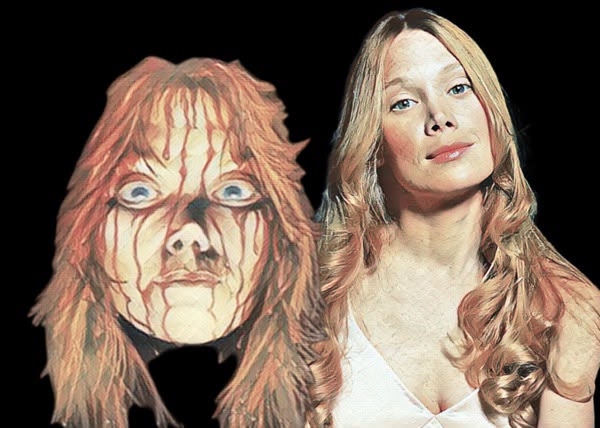
The decision was crucial. De Palma turned a collective catastrophe into an intensely intimate emotional experience.
Stephen King approved. Years later, he said the film was artistically more elegant than his own novel and praised both the direction and Sissy Spacek. It is an especially interesting comparison in light of the battle King would later wage against Stanley Kubrick over The Shining. With De Palma, he understood that the changes did not betray Carrie: they found a cinematic language for it.
Sissy Spacek was not supposed to be Carrie
Today it almost seems absurd to imagine another actress in the role, but Sissy Spacek had to fight for Carrie.
De Palma was not convinced she was his lead and found it easier to imagine her as Chris Hargensen, the girl who engineers the prom humiliation. When it came time for the decisive screen test, Spacek chose to do exactly the opposite of what one might expect from a young actress trying to win a Hollywood role. She put Vaseline in her hair, skipped makeup, and showed up in an old sailor dress her mother had made for her when she was still in school. While the other candidates tried to look beautiful, Spacek decided to look like Carrie. De Palma gave her the part.
That choice is one of the reasons the film still works. Spacek does not play Carrie as a creature waiting to become a monster. She is awkward, strange, almost painfully vulnerable and, at the same time, never completely passive. There is something about her that always seems on the verge of breaking or exploding. When she finally appears at the prom in the dress, with her hair done and a smile we hardly knew existed, the transformation is so striking that we immediately understand what is at stake.
Piper Laurie produced another kind of miracle. She had been away from movies for roughly 15 years when she returned as Margaret White. The character initially seemed so excessive to her that Laurie thought she was acting in something close to a black comedy. De Palma had to convince her that Margaret needed to believe absolutely everything she was saying. The result exists in that extraordinary space between frightening, grotesque, and almost operatic. Margaret may be monstrous, but she never seems to believe she is the villain in her own story.
And all you have to do is look around the cast to see how many people were still at the beginning of their careers. Amy Irving plays Sue, Nancy Allen is Chris, William Katt is Tommy, and John Travolta, shortly before Saturday Night Fever turned him into a star, appears as Billy Nolan.
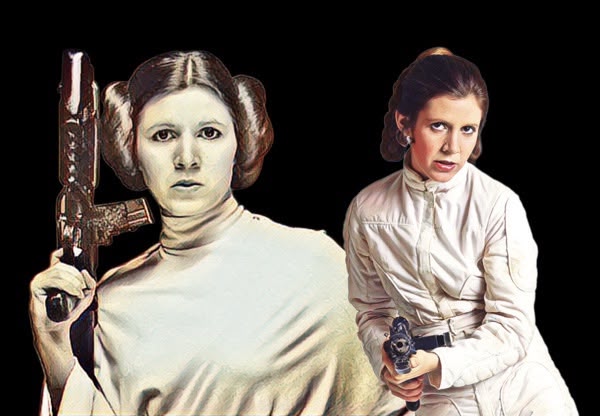
There is also a delightful piece of Hollywood history: George Lucas and Brian De Palma conducted part of the auditions for Star Wars and Carrie together. Young actors came in to be seen by both directors, while Lucas searched for Luke, Leia and Han and De Palma assembled his infernal high school. Amy Irving would later recall that she met De Palma during a Star Wars audition; P.J. Soles said she entered that process and ended up on the Carrie list. Two films from 1976 and 1977 that would help change Hollywood forever were, for a brief moment, looking for their young faces in practically the same room.
The film changes when Carrie walks into the prom
Everything leads to Brian De Palma’s real achievement.
We know Carrie is going to be humiliated. Even someone who has never read the book probably knows it. Today, there is no possibility of surprise at all: the image of the blood has become one of the most reproduced in horror history. De Palma, therefore, does not depend on what is going to happen. He depends on when it happens.
That is a huge difference. Carrie arrives at the prom expecting disaster before we do. She is used to being ridiculed and cannot understand why Tommy would want to be there with her. Little by little, he reassures her. They talk. They dance. The camera begins to circle around them and, for a few moments, the entire film seems to belong to another genre. There is romance, music, light, movement. Carrie laughs.
Roger Ebert understood this already in 1976. For him, the horror of the final minutes worked because it grew inevitably out of a character the audience already knew and understood; it was not a catastrophe artificially dropped into the end of a movie. Pauline Kael also recognized in De Palma’s work that very particular combination of lyricism, humor, perversity and suspense, in which we know we are being manipulated and allow ourselves to be carried along anyway.
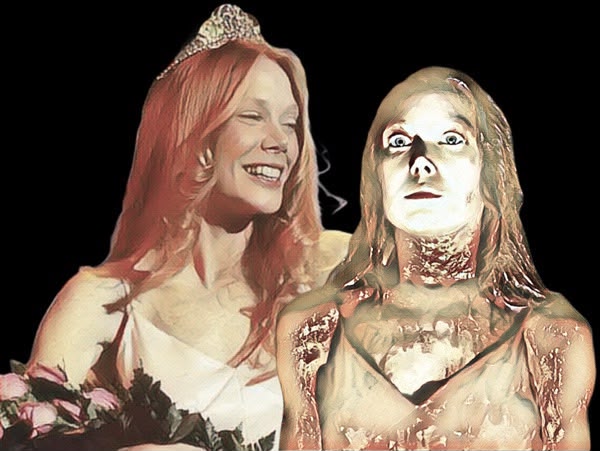
While Carrie dances, however, we know something she has finally managed to forget. The bucket is still there. De Palma prolongs her happiness precisely because he understands that the happier we are for her, the more violent the fall will be. The horror does not begin when the blood hits the dress. It begins when we realize Carrie believed.
Pino Donaggio and the ghost of Psycho
Music plays an enormous role in that construction. De Palma intended to work again with Bernard Herrmann, Hitchcock’s composer, who had already scored Sisters and Obsession for him. Herrmann died in December 1975, before he could write the score for Carrie. It was critic Jay Cocks who suggested Pino Donaggio, after hearing his extraordinary work on Nicolas Roeg’s Don’t Look Now.
Donaggio found the perfect tone because he did not simply write a horror score. His music can be delicate, sentimental, and romantic, almost as though it were accompanying the movie Carrie wishes her life could be. That is what makes the transition into horror so aggressive.
At the same time, Herrmann’s ghost remains everywhere. During editing, De Palma used temporary music from Psycho, Sisters, and other Herrmann scores. When Carrie’s telekinesis kicks in, those sharp string stabs deliberately evoke Psycho. It is not some hidden cinephile reference: De Palma wanted us to recognize that language of danger instinctively.
There is a great deal of Hitchcock in Carrie, but never as simple imitation. De Palma takes techniques we know and transforms them into something more feverish, sexual, adolescent, and excessive. The split screen during the massacre, the camera movements, the slow motion, Paul Hirsch’s editing and Mario Tosi’s cinematography turn the prom into a sequence that can be dismantled shot by shot and still retain its power.
The hand that refused to let Carrie die
And then there is the ending. After so much violence, De Palma apparently gives us silence. Sue Snell walks toward the ground where the White house once stood, approaches the flowers placed beside a sign, and, at last, there seems to be room to breathe. Carrie’s hand bursts through the earth and grabs her arm. It is a dream, of course. It hardly matters.
The image became a kind of ancestor to countless final shocks in modern horror. The story has ended, the monster is gone, the victim has survived, and then the film reminds us that trauma never obeys the credits.
Carrie was a major commercial success and achieved something still unusual for horror: it put Sissy Spacek and Piper Laurie at the Oscars, for Best Actress and Best Supporting Actress respectively. The film was not received simply as an efficient machine for scares. Major critics saw in it what remains obvious 50 years later: beneath the telekinesis is a terribly recognizable human story.
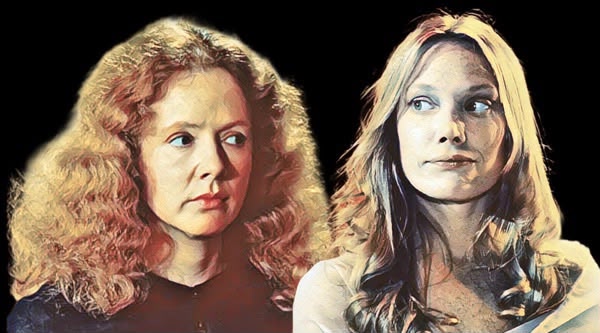
They tried again. And again. And again.
It is possible to make another Carrie. History has proved that. We had The Rage: Carrie 2 in 1999, functioning as a sequel; Angela Bettis took on the role in a 2002 television film; Chloë Grace Moretz and Julianne Moore starred in the 2013 adaptation; the musical reached Broadway and developed its own cult history. Now Mike Flanagan has turned the novel into a series.
But there is a difference between retelling a story and replacing an image. None of the later versions managed to do that. Perhaps because De Palma found something that does not depend on technology, period, or faithfulness to the novel. The dress, the blood, and the telekinesis can all be reproduced. Carrie’s happiness before the blood cannot.
That is where Sissy Spacek makes the film endure. During those few minutes, she is not a horror icon, she is not the supernatural teenager, and she is not yet the figure who would be imitated, parodied, and paid homage to for half a century. She is simply a girl discovering, in surprise, that she can be beautiful, desired, and accepted. William Katt looks at her without cruelty. People applaud. Her name is announced. For the first time, Carrie stands at the center of that school without wanting to disappear. And then De Palma destroys everything.
The problem Mike Flanagan faces
That is why Mike Flanagan’s mission may be even harder than it seemed when his new version was announced. He does not simply need to convince a new generation that Carrie’s story remains relevant; that part is relatively easy. Bullying, fanaticism, repression, misogyny and public humiliation have unfortunately aged very well. Flanagan has also already shown that he knows how to uncover new layers in Stephen King, as he did with Gerald’s Game, Doctor Sleep, and The Life of Chuck.
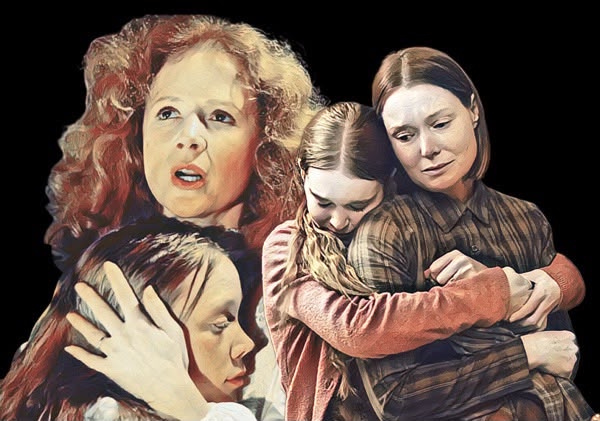
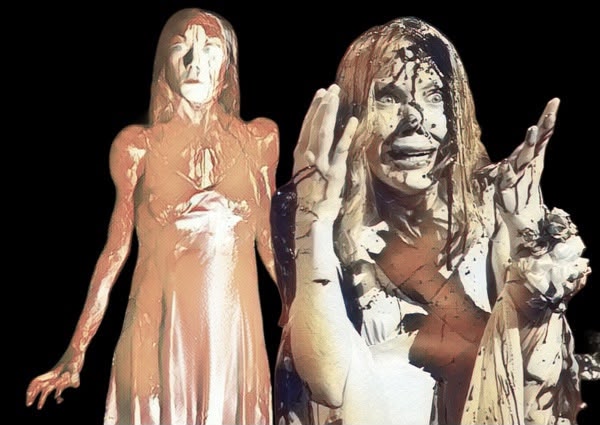
His real challenge is different. He has to create a Carrie who can exist alongside Sissy Spacek without trying to erase her. Because fifty years of remakes, sequels, homages, and references have proved something curious: we can change the school, the era, the mother, the bullying, the technology, and even the way the story is told. But all someone has to do is say Carrie, and we still see that girl standing completely covered in blood, staring at an audience she believes is laughing at her. It is a terrible image. But perhaps Brian De Palma’s real triumph is that, 50 years later, we still remember how happy she was just a few minutes before.
Descubra mais sobre
Assine para receber nossas notícias mais recentes por e-mail.


1 comentário Adicione o seu