
Spoilers for the final episode of Slow Horses Season 6.
The sixth season of Slow Horses ends with a desperate escape, a painful death, an extraordinary conversation between father and son, and a threat that keeps working even when everyone believes they have survived. “Judgment Day” uses its 61 minutes to bring together the storylines we have followed over the past few weeks. I said some of the connections were confusing, and they were. But the overall verdict is a great season, with very British humor, excellent performances, and character development that makes every new loss harder to accept.
The episode opens with Jane in a run-down bathroom, tending to her facial injuries alone after the crash Sid caused. There is blood, a mirror, and Russian music. Her expression reveals her determination without any need to explain her desire for revenge. She picks up a map with an address marked on it and leaves. For those who followed our previews of the books, the threat already carried particular weight. For the characters, Jane is still a problem they would like to consider resolved.
Meanwhile, MI5 agents search for Sid across an open field. River, battered after fighting his own colleagues to let her escape, is not providing the help they expect. He continues protecting Sid and provokes the men holding him until they leave him behind, forcing him to find his own way back.
His first move is to call Lamb. He tells him Sid escaped, explains what happened at the airfield, and asks for help. Lamb responds with his usual irritation, but the conversation takes on a different weight when River tells him Coe is dead. Even in a man who rarely displays an obvious emotional reaction, the loss registers. The reminder of “Moscow rules” brings River back to the immediate need to watch his back.
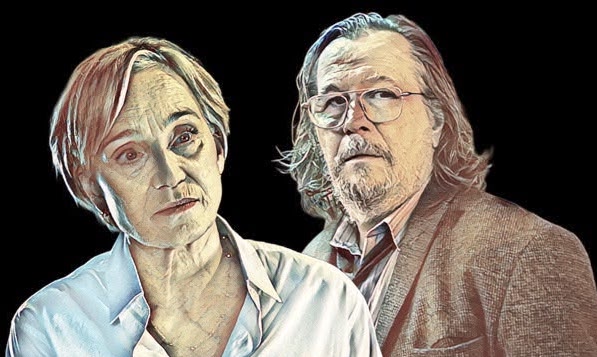
Diana can no longer pretend she has the situation under control either. When she meets Lamb, she has to explain the Kazan operation, the money that financed it, and the pressure she has been under. The attempt to hand Sid over to the Russians has failed. Now she is considering admitting what she did and stepping down.
It is an excellent introduction to the reckoning we were expecting after our piece about why the two needed to join forces. The impeccably dressed woman is sitting in Lamb’s filthy car, admitting she cannot see a way out. He listens, makes the connections, and identifies a path forward. But Diana will have to listen to him and follow his instructions. Gary Oldman and Kristin Scott Thomas play the reversal with delicious precision: she holds the position, but at that moment, he is the one who knows what to do.
Lamb recognizes the importance of Natasha Carrington, Cantor’s connection to Russian interests. His investigation takes him to her house during a children’s party. Naturally, discretion is not his chosen strategy. He antagonizes the security guards, causes embarrassment, and gets himself admitted. Between the food and party activities, he is there to discuss murders and a deal that might prevent more of them.
The sequence also helps untangle the season’s confusion. Diana financed a clandestine operation with money whose origins compromised her. Cantor, Natasha, and the Russians exploited that vulnerability, while the stolen files put the slow horses in the firing line. The hunt for Slough House and Harkness’s operation intersect, but the people involved are not all pursuing exactly the same objective. Lamb finally stitches those threads together for us.
At Diana’s holiday home, nobody is being particularly discreet. The slow horses are eating, taking over the rooms, and wearing the owner’s clothes. Simply imagining Diana witnessing the situation is enough to sustain some of the comedy. The problem is that outside, Frank Harkness and two men are preparing to attack.
River reaches the hideout before the siege closes in. Inside the house, Shirley is furious about Coe’s death and the succession of losses. Being around Louisa creates friction too, including over the diamonds she kept after the events of Season 2. Old resentments remain present even when the emergency should force everyone to focus solely on surviving.

Harkness’s attack ends the argument. The house no longer offers protection, and the group flees toward the beach. From there, the sequence follows people who are separated, exposed, and trying to improvise a defense against armed men.
Roddy carries Reece and heads off with Emma and Shirley. River stays with Catherine, Louisa, and Moira, who injures herself during the escape. The open landscape offers no freedom: there is nowhere to hide, little equipment, and no safe way to call for help. The pursuit splits the team precisely when staying together would matter most.
Emma takes charge of defending her group and manages to protect Roddy, Shirley, and Reece, but Harkness shoots and kills her. She still manages to take down one of the attackers. The other continues the pursuit, and the harpoon Shirley finds becomes their chance to fight back. She teaches Reece how to use it, and he is the one who hits the second man.
Emma Flyte’s death is the episode’s most painful loss. Ruth Bradley had been developing a character who was finding an increasingly interesting place alongside the slow horses. Her growing involvement in their world preserved the competence and discomfort of someone who knew the Service from a different position. Losing Emma after Coe makes this season particularly cruel.
Roddy is shaken, and Christopher Chung deserves special recognition. The hacker remains arrogant, inappropriate, and incapable of seeing himself as others see him, but he is no longer confined to delivering a joke. His time with Reece and his reaction to Emma’s death bring vulnerability to the character. It is a very interesting arc because Chung lets that change emerge without erasing what makes Roddy who he is.

The Russian threat arrives while the group is still trying to escape Harkness. Jane reappears and shoots Louisa, who manages to return to Catherine and Moira but is seriously wounded. River goes after the assassin and ends up in another confrontation inside the house. She wounds his hand, gains the upper hand in the fight, and throws him down the stairs. After everything he has endured to save Sid, it looks as though the pursuit will finally end with his death.
At this point, Lamb’s help still needs to reach the beach. Catherine manages to contact him, and his intervention connects the episode’s two fronts: by putting pressure on Cantor, he forces the businessman to order Harkness to stop the attack. He also tells Diana that his agents need rescuing at her holiday home. Events finally begin to work in their favor.
Harkness, already wounded, returns to the house. When Jane comes downstairs after River, he shoots and kills her. The agent who seemed determined to continue the pursuit at any cost meets her end at the hands of the man who was also attacking the slow horses. Amid those competing interests, Frank saves his son’s life. And then comes, for me, the episode’s best sequence: River and Harkness sitting at the table, talking.
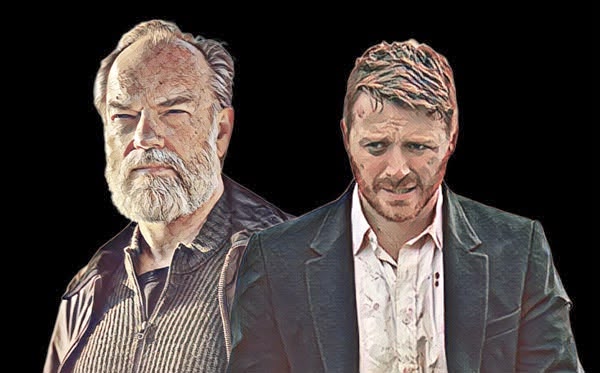
Jack Lowden and Hugo Weaving find an extraordinary mixture of tension and humor in a situation where any attempt at normality is already absurd. Frank treats what he has just done with a disconcerting casualness, while River tries to understand the boundary between convenience and something that might be a paternal feeling.
The son recognizes what matters: Harkness could have killed him, and he did not. There is an acknowledgment in that encounter that could even be read as pride, although it hardly turns Frank into a trustworthy father. He has just killed Emma. The series keeps that violence present while allowing his relationship with River to reveal another nuance.
It is very British humor, sustained by discomfort, by the way things are said, and by what neither man can directly admit. Weaving suggests a particular connection to his son without needing to make Harkness affectionate. Lowden maintains River’s distrust, but also his difficulty in ending that story with a bullet.
When MI5 backup approaches by helicopter, River tries to stop his father from leaving. But he cannot bring himself to shoot him, and Harkness escapes once again. The conversation ends without resolving their bond. Frank leaves his son alive, with plenty of new questions and more reasons to distrust his own family history.
Meanwhile, Diana carries out her part of Lamb’s plan. She approaches Cantor and makes the businessman believe the situation has been exposed and he needs to leave the country. The possibility of the Russians learning how the money was used terrifies him. Cantor accepts the escape Diana offers without realizing he is walking into another trap.
Lamb has offered Natasha a replacement for Sid: Cantor can be handed over as the man responsible for the operation. The man who believed he controlled the head of MI5 becomes the bargaining chip used to resolve the problem. The journey he imagines will save him puts him on a path straight to Vassily.
Diana keeps her position, Sid is no longer the necessary sacrifice for that agreement, and Lamb manages to stop the slaughter of his agents. He remains in charge of Slough House, with no promotion or public change in his status. But Diana now owes him her professional survival.
That debt gives the ending a particular flavor. She had to acknowledge the competence of the man she would prefer to keep at a distance and submit to his instructions. Their collaboration works because both know the job, although the way they approach its human cost is far from equivalent.
After the violence, the survivors gather at the church to honor the dead. Louisa arrives on crutches, confirming she survived the shooting. The relief is considerable, but the gathering also makes the absences painfully clear. The team is smaller, more battered, and carrying fresh losses. Louisa, incidentally, still has no desire to return to life in the Service.

They raise a toast with David Cartwright’s whisky, and for a moment, it seems possible to end the episode with that acknowledgment among those who remain. But Catherine has a message for River: one of his grandfather’s neighbors has reported that the light is on in the house.
River understands the signal. Sid had said she would leave a light on for him. After spending the episode off-screen, she reenters the story as the possibility of a reunion. He goes to his grandfather’s house with very different expectations from those he had when he arrived there earlier in the season.
As he prepares the room, however, River picks up the crowbar left on the kitchen counter. There is a substance on its surface. He rubs his fingers, noticing something strange, but the contact has already happened. Shortly afterward, he becomes ill, convulses, and loses consciousness.
The threat recalls Jim’s earlier visit to the house and the container he handled so carefully. The episode points to poisoning from a substance left on the object. The pursuit continues to have consequences even after the assassins are dead.
It is a cruel cliffhanger because River has survived so much, only to be struck when he believes he is safe. The place associated with his grandfather and the promise of seeing Sid becomes the setting for another threat to his life. The ending does not confirm his death: it stops the story before we know whether anyone will be able to help him.
Those who followed our pieces about River and Sid and the books were already prepared for an attack with serious consequences. The adaptation changes the mechanism from the novel, but preserves the question that matters now: what will this experience do to River, if he survives?
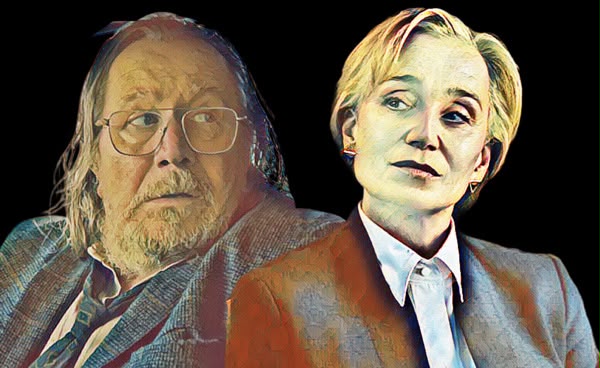
The Season 7 preview maintains the series’ tradition and connects with what we anticipated about Bad Actors, Mick Herron’s eighth novel. James Callis returns as Claude Whelan, and Diana will have new problems. Varada Sethu, Ethan Moorhouse, Tuppence Middleton, Merab Ninidze, and Joshua McGuire are among the announced cast members, as we detailed in our piece about the next season’s ensemble.
We had also noted that, in the book, the consequences of the attack keep River out of the main action. That does not mean Jack Lowden is leaving, nor does it determine how much the television adaptation might show of the character. That information now carries a different weight after the season’s final image.
There were moments when we struggled to connect the parallel storylines, until Lamb finally established what everyone wanted and who was paying for it. Even so, this was a great season. The action maintained its urgency, the humor emerged in the most inappropriate situations, and the characters continued to grow. With a team that is increasingly wounded and diminished, Slow Horses makes us worry more about its misfits every year. After this ending, waiting for River will be especially difficult.
Descubra mais sobre
Assine para receber nossas notícias mais recentes por e-mail.

