
Warning: This article contains spoilers for Episode 9 of Silo Season 3.
If the world were going to end, perhaps no one would be better suited to sing its farewell than Peter Gabriel. That is exactly what happens in “Farewell,” the spectacular ninth episode of Silo Season 3, when the series finally reveals the cataclysm that wiped out humanity and forced the survivors underground.
Gabriel is not present merely on the soundtrack. He appears as himself, among the guests touring the silos during what is officially supposed to be an inauguration event. As the future residents explore the facilities, compare accommodations, and discuss which silo would be the best — Silo 17 is apparently the most desirable — no one realizes that they will never be going home.
The tour is a lie. The inauguration is a trap. And the silos are not an architectural curiosity: they are the only possible destination after the end.
It is within this context that Peter Gabriel sings “Here Comes the Flood.” Not about the apocalypse in retrospect, but practically as it happens. At least in the fictional world of Silo, then, Peter Gabriel survived the end of the world, and provided its soundtrack.

Three Peter Gabriel songs in Silo
The singer’s presence in “Farewell” did not come out of nowhere. Peter Gabriel has gradually become a kind of parallel musical voice for Silo, with three of his songs chosen for pivotal moments in the story.
The first was “Red Rain,” used in “Solo,” the third episode of Season 2. Released on the 1986 album So, the song grew out of Gabriel’s recurring images of red rain, bodies and destruction. Within the story he had imagined around the character Mozo, the rain appeared as a punishment descending upon a community. In Silo, it accompanied the arrival in a devastated space, marked by the deaths of its residents and the water consuming its lower levels.
Season 3 began with “Come Talk to Me” over the end credits of “Who Are You?”. The song was released on the 1992 album Us, with Sinéad O’Connor singing alongside Gabriel. He wrote it out of the breakdown in communication with one of his daughters after the end of his marriage: it is an urgent plea for someone to break the silence and re-establish contact.
Paula Cole, who is frequently associated with the song, does not appear on the original recording. She sang “Come Talk to Me” with Gabriel during the Secret World Tour, in the famous staging that had him trapped inside a telephone box, trying to reach the singer on the other side of the stage.
The choice for “Who Are You?” was not received in the same way by everyone. Some viewers found the song’s arrival over the credits unexpectedly expansive for the episode’s dark tone. But now, with the season nearly complete, it acquires another meaning. Silo began by asking someone to speak, cross the distance, and break through the isolation.
In Episode 9, we discover that this contact will not happen in time. That is when “Here Comes the Flood” arrives.
The progression of the three songs almost seems to form a narrative of its own: first the red rain, then the plea for communication and, finally, the flood.

Helen and Daniel: separated as the world ends
The choice of “Here Comes the Flood” becomes even more painful because the cataclysm is not presented merely as a spectacle of destruction. Silo turns it into an intimate tragedy through Helen and Daniel, separated at the precise moment when there is no longer any way back.
Helen is pregnant and will be taken to Silo 18. Daniel remains in Silo 1. They still believe they may be able to reunite, but we know what this division means. It is not a temporary trip or a professional commitment. It is a separation designed to last for generations.
The tension builds slowly as people tour the facilities, talk, eat and make plans for later. They behave like visitors because they do not yet know that they have already been selected as survivors, or prisoners. The ordinariness of the event makes everything crueller: the world ends while they believe they are attending a party.
“Here Comes the Flood” enters precisely during this transition from expectation to horror. The lyrics speak of warning signals, islands that can no longer provide protection, and people forced to say goodbye to their own flesh and blood. In “Farewell,” the image ceases to be abstract. Helen and Daniel are separated at the same moment humanity is torn away from the world it knew.
The flood has arrived, but there is no water. There is death, separation, and silence.
What does “Here Comes the Flood” mean?
Peter Gabriel wrote “Here Comes the Flood” shortly after leaving Genesis in 1975. The song was released in February 1977 on his first solo album, Peter Gabriel, produced by Bob Ezrin, in a grand recording featuring an orchestra and musicians such as Robert Fripp and Tony Levin.
Gabriel, however, considered the result overproduced. He later revisited the song in much simpler arrangements, essentially stripped down to voice and piano. Without the orchestral grandeur, the song acquired a vulnerability even more appropriate to the end of the world shown in Silo.
Despite its title, Gabriel did not originally write it about a literal flood. The inspiration came from his fascination with shortwave radio. He noticed that, as night fell, distant signals became stronger and previously inaccessible voices began travelling through the darkness.
From that image, he imagined a kind of psychic flood. The barriers protecting our thoughts would disappear, giving everyone access to each other’s minds. Those accustomed to living openly would be able to navigate the current. Anyone dependent on secrets, lies and isolation would be unable to survive it.
The water therefore represents information, memory and collective consciousness. Once the flood arrives, there are no hiding places or individual islands left. Everything once concealed rises to the surface.
In “Farewell,” the lyrics also become painfully literal. The cataclysm was anticipated by a small group and concealed from almost all of humanity. As people tour the silos, only a few know that the warning signals are real. By the time everyone else understands, there is no choice, escape or time left for goodbyes.
Peter Gabriel survives the apocalypse
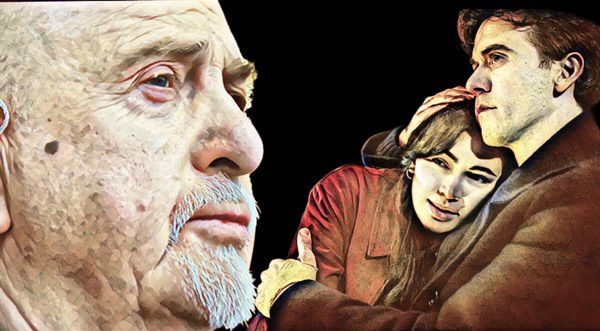
That is what makes Peter Gabriel’s appearance much more than an amusing cameo or an excellent musical choice. He is among the people being led into the silos, singing a composition written almost 50 years earlier about the collapse of barriers and the arrival of a collective catastrophe.
“Red Rain” anticipated the destruction. “Come Talk to Me” asked people to reach across the silence. “Here Comes the Flood” confirms that it is already too late.
There is also a delightful irony in turning Peter Gabriel into a character within the story. At least in the world of Silo, he was in the right place when the world ended. He survived the cataclysm and entered one of the silos, taking one of his most beautiful songs with him.
For Helen and Daniel, however, there is no possible comfort. They are not separated because they have given up on each other, but because a much larger project has decided where each of them must survive. No telephone, road, or conversation will be able to cross the distance imposed between the silos.
The season began with Peter Gabriel asking: come talk to me. In its penultimate episode, he appears in person to announce that the flood has arrived. And the world ends in Silo to the sound of someone singing a farewell.
Descubra mais sobre
Assine para receber nossas notícias mais recentes por e-mail.
 miscelana.com
4 comentários Adicione o seu