
The world knows some version of the Lizzie Borden story. In the United States, her name practically belongs to folklore; elsewhere, the case may not carry quite the same weight, but movies, television, books, theater, and even ballet have ensured that the image of the daughter who supposedly hacked her father and stepmother to death has survived for more than a century.
There is just one problem with that sentence: Lizzie Borden was never convicted of killing anyone. She was tried and acquitted. Andrew and Abby Borden remained dead. No one else was ever prosecuted for the murders. And 134 years later, although popular culture has essentially treated the case as solved, it remains, in every meaningful sense, a cold case.
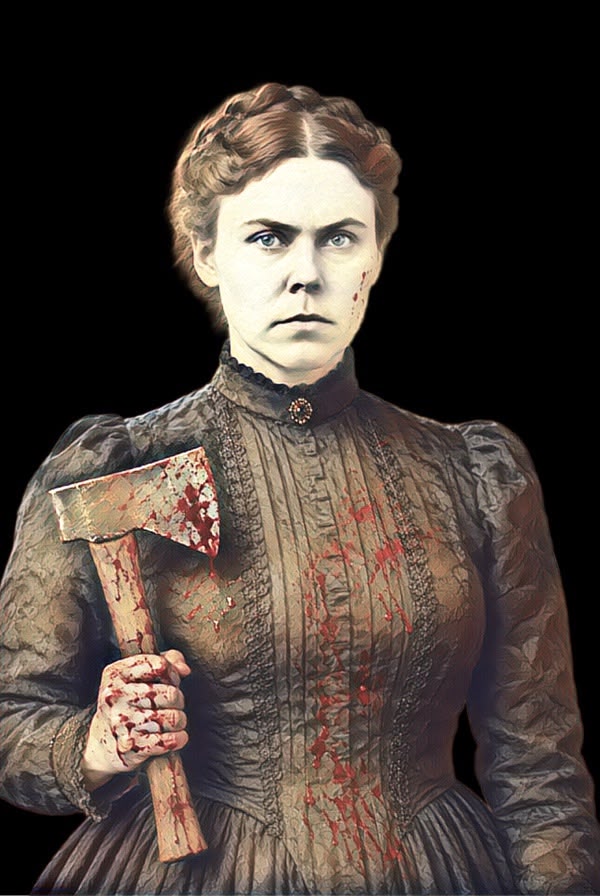
With Monster: The Lizzie Borden Story premiering on Netflix on September 17, I could go back to the theories or try to anticipate which version Ryan Murphy and Ian Brennan have chosen. I would rather wait until I have actually seen what they have done. Netflix has already made it clear that its version embraces a fictionalized, guilty Lizzie, which makes it even more interesting to return to the real story before fiction hands us its answer.
So I went to the case files. I went through police witness statements beginning on August 4, 1892 itself, the preliminary hearing and the two enormous volumes of the 1893 trial transcript, all now available for research. It is fascinating reading because, stripped of decades of movies, books, rhymes and theories, the documents restore to the case the very thing the legend has taken away from it: doubt.
They preserve searches, suspects, contradictory testimony, abandoned leads, and the legal battles that would eventually lead to Lizzie’s acquittal.
And the more you read, the more uncomfortable the question becomes: if Lizzie Borden did not do it, who killed Andrew and Abby?
A Crime Popular Culture Solved Before the Law Did
The power of the Lizzie Borden case lies in an apparent impossibility.
Abby Borden was killed first, in the upstairs guest room of the family home in Fall River, Massachusetts. Andrew returned home later, lay down on the sitting-room sofa, and was murdered as well. Examination of the victims’ stomach contents suggested a significant difference in the stages of digestion, supporting the conclusion that the two deaths occurred some time apart.
That creates the first major problem for any theory. The killer had to murder Abby and remain nearby for a considerable period — or leave and somehow return unnoticed — before killing Andrew. And this was not exactly a house people could wander freely in and out of.
Police records show how much attention was paid to doors and access points. One officer who later guarded the house for thirteen days said the front door locked when it closed and that he never saw anyone enter without somebody inside opening it.

On the morning of the murders, besides the victims, Lizzie and the family’s maid, Bridget Sullivan, known in the household as Maggie, were on the property. Lizzie’s older sister Emma was away. Their maternal uncle, John Vinnicum Morse, had slept in the house the previous night but left that morning.
There was no eyewitness. No confession. The murder weapon was never conclusively identified. No blood-soaked clothing was definitively tied to Lizzie.
The case against her was built essentially on circumstantial evidence. In the final instructions, the court reminded the jurors that nobody had seen Lizzie commit the murders and that the Commonwealth depended on a chain of circumstances strong enough to establish her guilt beyond a reasonable doubt.
That is precisely where the mystery begins — the mystery no nursery rhyme about an axe has ever been able to solve.
Why Was Lizzie Borden Considered a Suspect?
Because, frankly, there were reasons to suspect her.
Lizzie was on the property. Her relationship with Abby was difficult. There were family tensions involving money and property. The investigative records themselves contain statements that Lizzie disliked her stepmother, and that the daughters had resented financial dealings Andrew made that benefited members of Abby’s family.
Then came potentially devastating information. Eli Bence, a drugstore clerk, testified that on the morning before the murders, Lizzie had entered the store and asked for ten cents’ worth of prussic acid, a highly poisonous substance. He positively identified her.
Except Andrew and Abby had not been poisoned. Harvard professor Edward Wood examined the contents of both victims’ stomachs and found neither prussic acid nor evidence of an irritant poison.
There was also the mysterious note. According to Lizzie, Abby had received a message that morning asking her to visit someone who was ill. The note was never found. Neither was its supposed sender. That became particularly suspicious because after Andrew was found dead, Lizzie spoke as though Abby were away from the house — when her body was already lying upstairs. The prosecution eventually treated the note as an invention and reminded the jury that no one ever came forward to confirm having sent it.

Then there is the famous barn. Lizzie said she had gone outside and spent some time in the upper level of the barn looking for lead to make fishing sinkers. One of the officers who examined the place recorded that he found no footprints in the dust except his own.
And then there is the dress. Three days after the murders, Lizzie’s friend Alice Russell saw her standing by the stove holding a skirt. Emma asked what she was doing. According to Russell, Lizzie replied that she was going to burn it because it was covered with paint.
Russell also testified that she saw no blood on the dress. If this were fiction, it would almost feel like too much evidence. In court, it turned out to be too little.
Who Could Have Killed Andrew and Abby Borden?
One of the biggest surprises for me while reading the documents was realizing how extensively the original investigation actually looked at other people.
There are pages and pages about unknown men, people seen on the streets, individuals who allegedly argued with Andrew, foreigners regarded as suspicious, tips received by police, and investigative trips made to check out various leads.
On the morning of the murders, Lizzie herself told police that a man had argued intensely with her father weeks earlier over a property matter and that another man had appeared at the house that morning asking to discuss a store. The intruder theory, then, was not invented a century later by true-crime enthusiasts. It existed in the 1892 investigation. The problem is that it never developed into a convincing alternative.
A man seen behaving suspiciously after the murders desperately tried to obtain transportation to New Bedford, offering money and repeatedly urging that they leave quickly. Several witnesses gave similar descriptions of him. Police recorded and investigated the story, but he was never directly linked to the Bordens.
Other leads were so flimsy that today they seem almost comic. At one point officers searched a pond for a possible hatchet and recovered a paper bag containing an old banana peel. The report described the discovery, apparently without irony, as highly suspicious.
There was also a far less amusing side to the investigation. Portuguese men and other immigrants repeatedly appear in the records as suspects. One Portuguese man was actually taken to the station after being seen withdrawing roughly sixty dollars — his own savings — from a bank while speaking little English. Once he satisfactorily explained himself, he was released.
In other words, police did look outside the Borden house for a killer. They never found one.


Could John Morse Have Killed the Bordens?
John Vinnicum Morse is almost too perfect a suspect for an Agatha Christie novel.
The brother of Andrew’s first wife, he unexpectedly arrived at the Borden house the day before the murders and slept in the very guest room where Abby would be found dead the following morning. Then he left the house. Naturally, police investigated him.
The problem is that his alibi held up extremely well. Morse said he had spent the morning visiting relatives on Weybosset Street. An investigator checked the story, and Mrs. Emery confirmed that Morse had arrived at approximately 9:40 a.m. and remained there until around 11:20.
He returned to the Borden house only after the murders. Morse remains irresistible material for conspiracy theories, particularly those involving planning or a hired killer. But at that point, we leave the documents behind. There is no evidence that he participated in the crimes.
Was Bridget Sullivan a Suspect?
Bridget Sullivan is even more intriguing because she was on the property.
She spent part of the morning washing windows. When Andrew returned home, she opened the door for him and later went upstairs to her room. According to her testimony, she had been there only a short time when she heard Lizzie calling her: someone had killed her father.
Bridget said she saw no stranger during that period and did not hear a door opening while she was upstairs. It is possible to imagine complicity. It is possible to suspect that Bridget knew more than she admitted. It is possible to invent a secret relationship between her and Lizzie — something fiction has already explored and which the new season of Monster again places at the center of its narrative. But that is precisely the point. Possibility is not evidence.

There is nothing against Bridget comparable to the accumulation of circumstances surrounding Lizzie. And that may be the greatest difficulty in treating Lizzie’s innocence as a solution to the crime: there is no second suspect who carries a similar combination of presence, opportunity, family conflict, contradictions, and subsequent behavior.
That does not prove Lizzie killed them. It explains why the case has never managed to free itself from her.
Why Was Lizzie Borden Acquitted?
The simplest answer is also the most important one: because the prosecution could not prove beyond a reasonable doubt that Lizzie killed Andrew and Abby Borden. But there is a fascinating legal story behind that sentence.
One of the prosecution’s strongest weapons was Lizzie’s own testimony at the inquest. Her answers contained lapses, contradictions, and changes. She had considerable difficulty explaining precisely where she was, when she had seen certain people, and how long she had spent in the barn. The jury, however, never heard it.
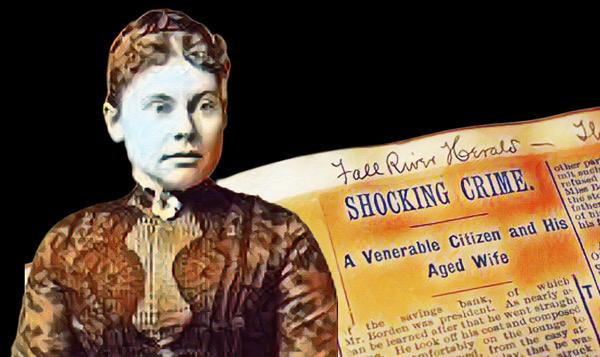
The three judges ruled that when Lizzie gave that testimony, she was already effectively in custody and being treated as a suspect in the murders. Her statements therefore could not be considered voluntary and were excluded from the trial. The court noted that, for legal purposes, she had been as much under the authorities’ control as she would have been after a formal arrest. It was an enormous victory for the defense.
Then came another.
The prosecution attempted to introduce the story of the prussic acid purchase. A lengthy legal argument followed. The defense pointed out that no sale had actually taken place and that no poison had been found in either body. That evidence was excluded as well. Two of the circumstances most damaging to Lizzie’s image had disappeared before the jury could consider them.
What remained was the possible financial motive, the difficult relationship with Abby, the strange barn alibi, the burned dress, the missing note and the enormous difficulty of imagining somebody else carrying out two murders inside that house without being seen. Enough to create suspicion. Not necessarily enough to send someone to her death.
The defense understood exactly how to exploit the distance between what appears probable and what can actually be proved.
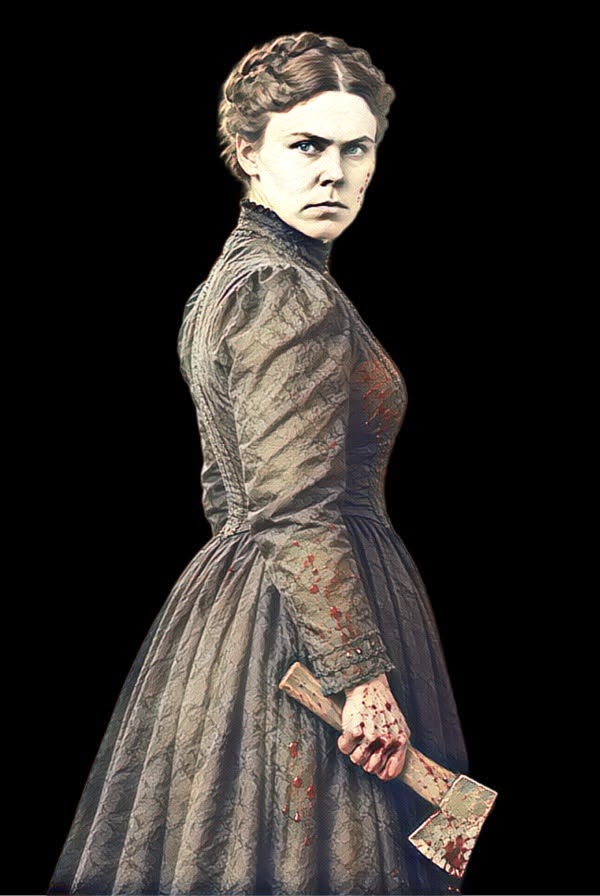
Did Misogyny Help Lizzie Borden Get Acquitted?
It is impossible to separate the 1893 trial from the way that society understood women.
The jury was entirely male. And those men were not merely being asked whether one particular person had committed two murders. They were being asked to imagine a white woman from a wealthy family, religious, unmarried, and known for church work committing an act of extraordinary physical violence. The defense understood that conflict perfectly.
In his closing argument, George Robinson asked the jurors to consider Lizzie as a woman among them and repeatedly emphasized the responsibility those men carried for a “young woman” whose life was in their hands. This is where the sexism of the period becomes contradictory.
The same ideal of femininity that restricted women socially could protect them when a prosecution required men to recognize in a woman the capacity for violence they associated with masculinity. And even the prosecution could not escape that trap. In describing Abby’s death, prosecutor Hosea Knowlton spoke of blows that had not come from the “strong hand of man”, but from the weaker blows of a woman. Even to argue that a woman had committed the crime, he had to explain how a woman would kill differently from a man.
That does not mean Lizzie was acquitted simply because the jurors were sexist. The case against her had genuine legal problems, relied heavily on circumstances, and had lost important pieces of evidence. But it is equally difficult to believe that gender played no role in how those facts were interpreted.
Class May Have Been as Important as Gender
There is a passage in the closing arguments that may be one of the most revealing moments of the entire trial. Curiously, it came from the prosecution.
Knowlton asked the jurors to imagine that everything suspicious about Lizzie had instead involved Bridget Sullivan. Bridget was poor, a domestic servant, an Irish immigrant, without Lizzie’s resources. The prosecutor contrasted her position with that of a woman protected by money, social standing, friends and excellent lawyers. And he essentially asked: if Bridget had told contradictory stories, produced a questionable alibi, and burned a dress after the murders, what would you think of her? Was there one law for Bridget and another for Lizzie?
Perhaps that question matters almost as much as discovering who held the axe. Because the Borden case was never only about gender. It was about gender, class, religion, respectability, and ethnicity.
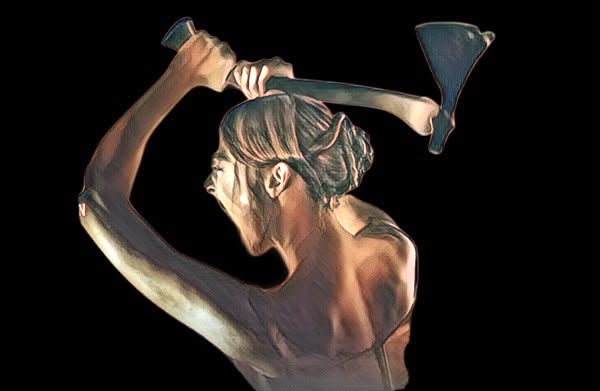

A poor immigrant could be taken to the police station for withdrawing his own money. Bridget could be viewed through the suspicion attached to someone without social status. And Lizzie could simultaneously be turned into a monster by the press and protected by the ideal of womanhood that same society had created.
There is even a small episode in the trial record that seems to encapsulate that world perfectly. Police found cloths stained with blood in the cellar. In a murder investigation in which no blood-soaked clothing had been found, that could have been explosive. The defense stated that the items had been used during Lizzie’s menstruation, described in court through the euphemism “monthly sickness,” and immediately said it had no intention of going into detail.
The matter virtually died there.
A Little Suzane Richthofen, a Little Elize Matsunaga
For a Brazilian, it is difficult to dive into the Borden case without finding familiar echoes. Not legally. Suzane von Richthofen and Elize Matsunaga were convicted. Lizzie Borden was acquitted. That distinction is essential. Culturally, however, Lizzie seems to contain elements of both.
From Suzane, there is the daughter from a privileged family, violence inside the domestic world, questions about money and inheritance, and, above all, the collective fascination with trying to reconcile the social image of a well-brought-up daughter with a crime that seems incompatible with that persona.
From Elize, there is the shock produced by extreme physical brutality associated with a woman, and the speed with which public judgment moves beyond the crime itself to invade personality, sexuality, relationships, appearance, and behavior.

They are very different women involved in very different crimes and contexts. The connection lies in the cultural mechanism.
When a woman commits — or is accused of committing — extreme violence, she often seems to have committed two transgressions: against the law and against the idea of what a woman is supposed to be.
Lizzie Borden discovered that in 1892.
The Jury Answered One Question. History Was Left With Another.
On June 20, 1893, the jurors retired to deliberate. When they returned, Lizzie stood. The clerk began the formal question, asking the foreman for the verdict. He did not even wait for the question to end. “Not guilty.”
Applause erupted in the courtroom. Lizzie dropped back into her chair. Shortly afterward, the court ordered her released. It is important to understand precisely what that verdict meant.
The jury did not solve the murders. It did not identify another killer. It did not establish that Lizzie could not have committed the crimes. It concluded that the Commonwealth had failed to prove beyond a reasonable doubt that she had. And perhaps that is exactly why Lizzie Borden never disappeared.


If tomorrow indisputable evidence emerged showing someone else entering that house, if a verifiable confession surfaced, or if some piece of evidence finally identified the killer, we would lose an essential part of the fascination. What turned Lizzie into a myth was not only the axe. It was the absence of an answer.
Popular culture solved the case a long time ago. It put the weapon in Lizzie’s hand and ended the story. Netflix is already presenting Monster: The Lizzie Borden Story through a version that assumes her guilt.
The documents from 1892 and 1893 offer no such comfort. After hundreds of pages of testimony, interrogations, suspects, poison, dresses, hatchets, strange men, alibis, and contradictions, I keep arriving at the same conclusion that has allowed this crime to survive for more than a century: there are many reasons to believe Lizzie Borden killed Andrew and Abby. They just never managed to prove it.
So What Do We Actually Know About the Lizzie Borden Case?
Did Lizzie Borden kill her father and stepmother? We do not know. She was charged with the murders of Andrew and Abby Borden, tried in 1893, and acquitted. No one else was ever convicted of the crimes.
Why was Lizzie Borden acquitted? Because the prosecution relied heavily on circumstantial evidence, important pieces of evidence were excluded, and the jury did not find her guilt established beyond a reasonable doubt.
Who killed Andrew and Abby Borden? The killer was never identified. Police investigated a number of people and leads, but no one other than Lizzie was ever brought to trial.
Is the Lizzie Borden case still unsolved? Yes. Although popular culture has largely treated Lizzie’s guilt as established fact, the murders of Andrew and Abby Borden remain officially unsolved.
Descubra mais sobre
Assine para receber nossas notícias mais recentes por e-mail.


2 comentários Adicione o seu