
The story of Lizzie Borden has come down to us as a nursery rhyme: Lizzie supposedly gave her father 40 whacks and her stepmother 41. Neither claim is true — not the number of blows, nor Lizzie’s guilt, since she was acquitted in 1893. But the rhyme survived because it provides what the real case never did: an answer.
That is precisely the answer Monster: The Lizzie Borden Story tries to construct. The series begins with real people and events, adds rumors accumulated over more than a century, and finally presents its own solution. In this version, Lizzie not only commits the murders but shares the crime with Bridget Sullivan, the family’s maid and her lover.
The problem is that this is fiction.
Rebecca Hall is excellent as Abby, but Vicky Krieps gives the series the atmosphere of a period drama in which women seem to spend their lives trying to breathe inside clothes, houses, and rules that are far too tight. Krieps plays both Bridget and Countess Elizabeth Báthory, a symbolic doubling designed to connect women accused of brutal crimes.
It works dramatically. Historically, it is another matter.
The Crime That Actually Happened
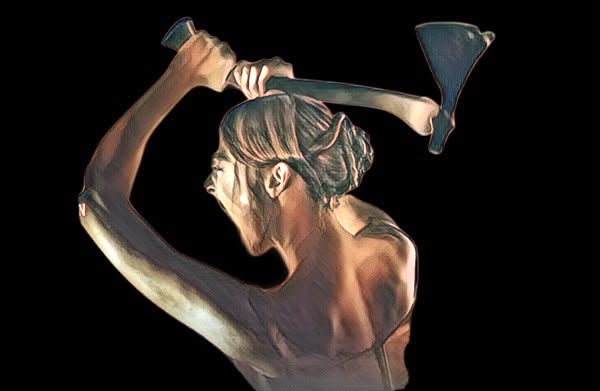
Andrew and Abby Borden were murdered inside their Fall River home on August 4, 1892. Abby died first, in the guest bedroom. Approximately 90 minutes later, Andrew was attacked while resting on the sitting-room sofa.
The blows were numerous and brutal, but there were not 40 and 41 of them, as the nursery rhyme claims. Abby was struck approximately 18 or 19 times; Andrew, ten or 11. The series accurately reproduces the locations of the bodies, the order of the deaths, and much of the strange activity inside the house that morning.
Bridget Sullivan, the Irish maid whom the Bordens called Maggie, really was washing windows. John Morse, the brother of Andrew’s first wife, had spent the night at the house and was among the last people to see the couple alive. He briefly attracted suspicion, although he produced an almost suspiciously detailed alibi.
Lizzie said she had spent part of the morning in the barn, looking for lead to use as fishing-line sinkers and eating pears. She also claimed that Abby had gone out after receiving a note asking her to visit a sick friend. The problem is that no one ever found the note — or the friend.
These are genuine elements of a crime that already resembled fiction long before Ryan Murphy came anywhere near it.
Did Lizzie Try to Poison the Family?
Shortly before the murders, members of the household became ill. The most likely explanation was food poisoning, hardly unusual in an era without proper refrigeration.
There was also an allegation that Lizzie had attempted to purchase prussic acid from a pharmacy, but the pharmacist refused to sell it to her. The incident was excluded from the trial because the judges found no sufficient connection between an attempted poison purchase and two deaths caused by blows from a hatchet.
Related to This: If Lizzie Was Acquitted, Who Killed the Bordens?
The series combines these two events and turns the family’s illness into a deliberate poisoning attempt by Lizzie and Bridget. It is effective dramatic preparation for the murders. As historical fact, it does not hold up.
The same applies to the poisoned oysters. They serve the narrative, but they do not prove that the two women were already testing ways to dispose of the family.
The Burned Dress and Other Genuine Suspicions
Not everything had to be invented to make Lizzie look suspicious. Days after the murders, her friend Alice Russell really did see her burning a dress. Lizzie explained that it had been ruined by paint. To the prosecution — and to every generation that followed — the timing seemed almost too convenient.
Emma, however, testified that the dress had already been stained and said that she herself had advised Lizzie to dispose of it.
Hatchets and axes were also found in the basement. None was ever conclusively identified as the murder weapon.
Andrew’s collection of special axes, including the almost fetishized tools shown in the series, did not exist. There were ordinary implements in a nineteenth-century household, not a personal arsenal carefully curated by the family patriarch.
Andrew Borden Did Not Exactly Own a Funeral Home
The series takes a genuine piece of Andrew’s biography and expands it into a horror story. As a young man, he had worked in furniture, coffins, and undertaking. By 1892, however, he was a wealthy businessman, property owner, investor, and director of banks and mills.
There is no evidence that he was still operating a funeral business at the time of the murders, much less that he mutilated corpses to make them fit inside cheap coffins.
The scene in which a female customer attacks Andrew in the street was also invented. It helps establish the idea that his cruelty and miserliness had created enemies throughout Fall River, but there is no historical record of the assault.
Was Andrew Abusive?
Andrew was known for being miserly. He tightly controlled the family’s money and forced his adult daughters to live far more austerely than his fortune required. The Borden home, for instance, stood in a commercial district, far from the fashionable neighborhood where Lizzie wanted to live.
The series amplifies this rigid behavior and turns him into a cruel patriarch capable of controlling and humiliating every woman in the house. It also invents a sexual involvement between Andrew and Bridget. There is no historical evidence that such a relationship occurred.
The production does not show Andrew sexually abusing his daughters. Incest theories have appeared in later speculation about the case, but they were never substantiated and should not be presented as part of the series’ narrative.
One thing is interpreting the oppressive structure of the Borden household. Another is presenting unproven abuse as fact.
Lizzie and Abby Really Did Not Get Along
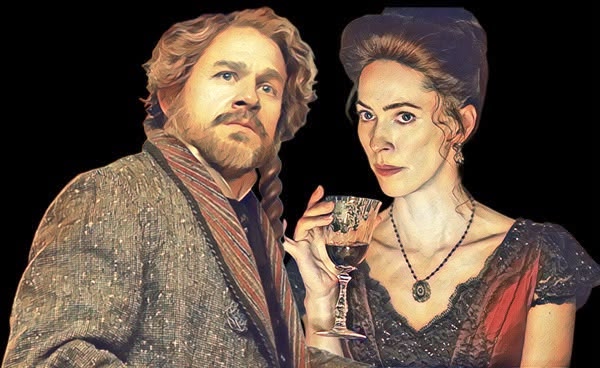
The tension between Lizzie and her stepmother is one of the series’ more plausible elements. Lizzie did not treat Abby as a mother and referred to her as “Mrs. Borden.” There were resentments involving Andrew’s money and the property he gave to members of Abby’s family.
But the production turns a strained relationship into open warfare. There is no evidence that Abby beat Lizzie, Bridget, or other women. Her incriminating diary is also an invention, as is the idea that she and Andrew were separating. The family doctor described their relationship as cordial.
Nor did Abby kill Lizzie’s pigeons. Andrew killed some of the birds, apparently because he considered them a nuisance or possible source of disease. The incident happened, but we do not know whether the pigeons were the beloved pets. Later mythology transformed into yet another motive for murder.
Related post: The Enigmatic Face of a Crime That Was Never Solved
Bridget Existed. The Lover and Accomplice Did Not
Bridget Sullivan was the Bordens’ maid and was in the house when the murders occurred. The family called her Maggie, apparently reusing the name of a previous servant. It is one of those small domestic acts of dehumanization that says a great deal without requiring help from a screenwriter.
There is, however, no evidence that Bridget and Lizzie were lovers. Nor is there proof that Bridget helped Lizzie poison the family or participated in the murders.
In the version the series ultimately embraces, Lizzie kills Abby, Bridget attacks Andrew, and the two women finish the crime together. This is not an established historical theory. It is the solution created by the writers.
The freedom represented by Bridget’s loose hair does at least have some cultural basis. Respectable adult women generally wore their hair up in public. Wearing it loose could suggest privacy, sexuality, or rebellion. But the symbolism belongs to the series. There is no record of the real Bridget using her hair in this way as an act of emancipation.
Did Bridget Leave Immediately Afterwards?
More or less. Bridget did not remain connected to the Borden sisters, but she did not disappear from Fall River immediately after the crimes.
She remained in the area during the investigation and was an important witness at Lizzie’s trial in June 1893. She later moved to Anaconda, Montana, probably around 1897. She married John Sullivan in 1905 and lived quietly until she died in 1948.
If the series suggests that Bridget left after the trial, it is compressing a broadly true trajectory. If it creates the impression that she fled immediately after the murders, it is accelerating the chronology.
Her later silence helped produce theories that she had been paid to disappear. No evidence of such a payment has ever been found. According to relatives, Bridget rarely spoke about the case.
Emma Lived in the House and Defended Lizzie
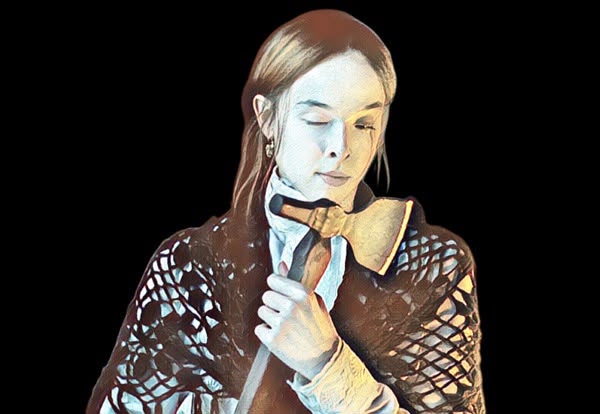
Emma, Lizzie’s older sister, never married and did live with the family. She simply was not in Fall River on the day of the murders: she was visiting friends in Fairhaven.
Emma genuinely testified for her sister, but her real testimony was far less emotional — and far more strategic — than the series makes it appear.
She supported the explanation that the burned dress had been stained with paint and said she had advised Lizzie to get rid of it. She also denied the account of a jail employee who claimed Lizzie had said, “Emma, you have given me away, haven’t you?” Emma provided information about the family’s property and Andrew’s financial gifts as well, helping the defense undermine the theory that Lizzie had killed solely for an inheritance.
This does not mean Emma delivered a grand speech about her sister’s innocence. She confined herself to challenging details that could be used by the prosecution. She did not claim to possess information proving who committed the murders.
Publicly, however, Emma maintained that Lizzie was innocent. After the acquittal, the sisters bought Maplecroft, a far more elegant house, and lived there together for approximately 12 years.
Emma left in 1905, saying that conditions had become “absolutely unbearable.” She never publicly explained what she meant. The sisters never spoke again and died only nine days apart in 1927.
Emma did defend Lizzie, and their later estrangement was also real. What the series invents are the dialogue, the chronology, and the idea that Emma knew exactly what had happened and consciously lied to save her sister.
Nance O’Neil Arrived More Than a Decade Later
Nance O’Neil existed and was a famous actress. She also developed a close friendship with Lizzie, prompting rumors that the two women were lovers. A romance is possible, but it was never proven.
The problem is the chronology. Nance met Lizzie around 1904, more than a decade after the murders and the trial.
She did not dine with Andrew and Abby. She was not present at the trial, nor did she train Lizzie to play the part of the innocent daughter. The scene in which she helps the defendant construct her courtroom performance is entirely fictional.
There really was a dinner involving Lizzie, Nance, and members of the actress’s theatrical company. But it took place at Maplecroft many years later. The series transports Nance back to 1892 because she is simply too good a character to leave in the future.
Incidentally, Nance is played by Jessica Barden, who also portrayed the young Valya Harkonnen in Dune: Prophecy.
The Blood Countess and the Convenient Book
Elizabeth Báthory, the so-called Blood Countess, was a Hungarian aristocrat accused of torturing and murdering numerous young women. She was never formally tried and spent the rest of her life confined.
The famous story that she bathed in her victims’ blood emerged later and does not appear in contemporary testimony. The figure of 650 victims should also be treated cautiously: it comes from a later claim, not a verified count.
In the series, Vicky Krieps plays both Bridget and Báthory, creating a symbolic connection between the two women. It is an interesting casting decision, not a historical link.
There is no evidence that Lizzie had any meaningful knowledge of the countess or drew inspiration from her. The French book given to her works as foreshadowing, but it belongs to fiction.
Yes, There Was Another Ax Murder in Fall River
Bertha Manchester really was murdered with an ax in Fall River in May 1893, approximately nine months after the Bordens and shortly before Lizzie’s trial.
It is one of those facts so perfectly suited to television that it almost seems invented. The series, however, absorbs the case into its conspiracy: Bridget supposedly had been “lent” to Bertha’s household, where she was abused, creating another bond among the women.
There is no proof that Bridget worked in the Manchester home, that she was beaten there, or that Bertha was a close friend of Abby’s. Lizzie could not have committed the second crime either: she was in jail awaiting trial. José Correa de Mello, a worker on the property, confessed and was convicted.
Two ax murders in the same city within less than a year? True. A secret connection between them? Fantasy.
The Heads Really Were Removed
This is one of the series’ most macabre details — and one of the details that actually happened.
During a second autopsy, conducted about a week after the murders, Andrew and Abby’s heads were removed. Their skulls were prepared and preserved as evidence so doctors could compare the injuries with the confiscated hatchets.
On June 5, 1893, the skulls were displayed in court. Lizzie fainted when she saw them.
The fainting is documented; its cause obviously is not. It could have been genuine shock, horror at seeing the remains of her father and stepmother, the heat inside the courtroom, or even a theatrically useful reaction.
It is one of the rare moments when Ryan Murphy did not need to heighten the horror. The real trial had already placed the victims’ skulls on a table in front of the defendant and the jury.
Was Lizzie Really Acquitted?
Yes. Lizzie Borden was tried for the murders of Andrew and Abby and acquitted on June 20, 1893. The all-male jury took approximately 90 minutes to return a verdict of not guilty.
But there is an important distinction between being acquitted and having one’s innocence proven. The trial concluded that the prosecution had failed to establish Lizzie’s guilt beyond a reasonable doubt. It did not determine who committed the murders or produce affirmative proof that she had not done so.
The case against Lizzie was entirely circumstantial. There was no eyewitness, confession, blood on the clothes she was wearing, or weapon conclusively tied to the wounds. The investigation had also been handled poorly, with neighbors and other visitors moving through the house before the crime scene was properly secured.
Two potentially damaging pieces of evidence never reached the jury. Lizzie’s contradictory inquest testimony was excluded because she had been questioned without a lawyer under circumstances the court considered coercive. The alleged attempt to purchase prussic acid was also ruled inadmissible because it had no direct connection to deaths caused by a hatchet.
Her social position and gender probably helped. For many men of the period, it was difficult to imagine that a white, unmarried, churchgoing woman from a respectable family could be capable of such violence. The prosecutor had to convince the jury not only that Lizzie had murdered two people, but that a woman like Lizzie could have done it.
She walked out of the courthouse a free woman and reportedly declared herself “the happiest woman in the world.” Fall River, however, never granted her the same acquittal. She remained socially marked, was avoided by much of the community, and continued to be the chief suspect in the popular imagination until her death.
So yes, Lizzie was legally cleared. Historically, the most we can say is that she was acquitted. The justice system closed the trial; the mystery remained open.

The Two Versions of the Murders
The series presents two versions. First, it returns to the popular image of Lizzie wielding the hatchet alone. It then offers what it treats as a revelation: Lizzie and Bridget committed the crimes together.
Neither version was ever proven.
Lizzie never confessed, Bridget was never charged as an accomplice, and the murder weapon was never conclusively identified.
The series does not solve a historical mystery. It chooses an answer and stages it with the confidence of someone who has finally found the missing piece.
Aileen Wuornos: Paulson Is Excellent, but the Detour Still Feels Forced
Sarah Paulson is, once again, extraordinary. That does not prevent the Aileen Wuornos section from feeling like a digression designed to fill out the season and connect two women transformed into monsters by popular culture.
There is no evidence that Aileen introduced herself as Lizzie Borden, was obsessed with her, or conducted imaginary conversations with the alleged murderer.
Many books about Lizzie existed by Aileen’s lifetime — the first significant account was published in 1893 — so she could conceivably have known about the case. What does not exist is any proof that she read those books or identified with Lizzie.
There is also no record that Aileen Wuornos ever visited the Borden house. The stay depicted in the series is chronologically impossible: Aileen was arrested in 1991, while the former Borden residence did not open as a bed-and-breakfast until 1996. The entire visit, like Aileen’s obsession with Lizzie, was created by the writers. People
Paulson saves Aileen as a character. Aileen does not save the series from smelling like filler.
Did the House Become a Hotel?
The murder house still stands in Fall River and has operated as a themed inn and museum since 1996. It is not exactly a conventional hotel, but a bed-and-breakfast where visitors can sleep in the historic rooms — including the room where Abby’s body was found — take guided tours, and participate in paranormal experiences.
In a way, it is the perfect fate for the Lizzie Borden story. The house where no one could prove what happened has turned uncertainty into a tourist attraction.
Between Fact and Fantasy
Monster gets the setting right, along with the basic chronology, the bodies, the burned dress, the missing note, the family’s illness, the skulls displayed in court, Emma’s support, and Lizzie’s acquittal. It also understands something true about that house: it was a suffocating environment shaped by money, resentment, hierarchy, and women with little autonomy.
What the series does not have is evidence for almost everything it presents as an explanation. The romance with Bridget, their partnership in the murders, Andrew’s sexual involvement with the maid, Abby’s diary, Nance’s intervention, the inspiration drawn from Báthory, the revenge against Bertha Manchester, and Aileen’s identification with Lizzie were invented or enormously exaggerated.
Perhaps it is impossible to tell this story without fantasizing. The case itself survived because every generation placed its own fears and desires inside it: the monstrous daughter, the repressed woman, the secret lover, the victim who strikes back, the murderess the patriarchy refused to convict.
Ryan Murphy does the same. The difference is that, this time, fantasy arrives dressed as truth.
Descubra mais sobre
Assine para receber nossas notícias mais recentes por e-mail.


1 comentário Adicione o seu