
Anyone who is a fan of Ryan Murphy — and I deeply respect what he does — knew he was going to take liberties. We knew he would inflate the scale, add fantasies, turn rumors into scenes, and fill the gaps in the historical record with sex, blood, trauma, and women seeking revenge.
That is his method. Ryan Murphy does not enter a story to reproduce it. He enters it to discover how much excess it can withstand.
Although Monster: The Lizzie Borden Story was written by Ian Brennan, Murphy’s signature is everywhere: in the exuberant aesthetic, in the macabre transformed into camp, in actors working in completely different registers, and, above all, in the need to turn a real crime into a very contemporary thesis.
The problem is not the freedom. It is what the series does with it.
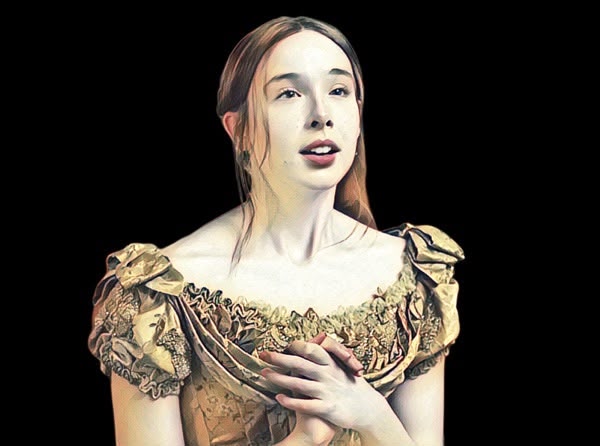
Eight Episodes for a Crime That Cannot Sustain Them
The story could have filled four episodes — six at most. Stretching it to eight gives Murphy room to be Murphy and indulge in his famous detours. Some are interesting; others seem to exist because the production needed to fill the time between the ax blows and the trial.
Elizabeth Báthory appears as a symbolic ancestor of female rage. Nance O’Neil is transported to a period when she had not yet met Lizzie. Aileen Wuornos crosses into the series almost a hundred years later, despite having no historical connection to the case. Flashbacks manufacture traumatic pasts for people about whom very little is known.
Many critics noticed the same problem. That does not mean everything is bad. It means the narrative loses its center. Instead of deepening the mystery, the series abandons it to manufacture increasingly obvious thematic connections.
Aileen Wuornos: Paulson Shines, but the Detour Still Feels Disconnected
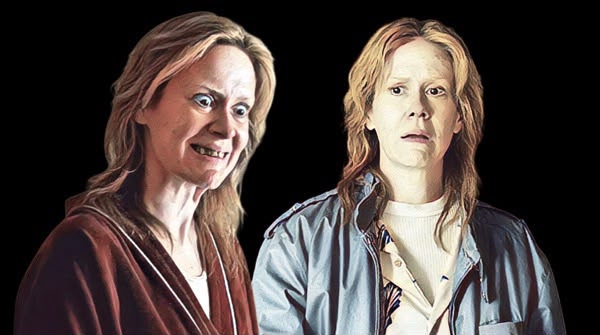
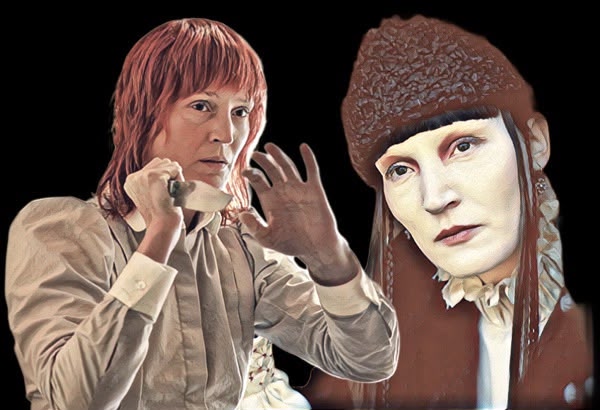
The inclusion of Aileen Wuornos gives Sarah Paulson yet another opportunity to shine. And she does. Her Aileen is nervous, unpredictable, physical, and uncomfortable to watch. Paulson enters with such force that she immediately raises another question: Why not make an entire season about Aileen?
The problem is that her material seems to belong to another production. There is no evidence that Aileen was obsessed with Lizzie, used her name, or visited the Borden house. The stay depicted in the series would have been impossible: Aileen was arrested in 1991, and the house did not open as a bed-and-breakfast until 1996.
The series attempts to justify the encounter as part of a lineage of violent women: Báthory inspires Bridget, Lizzie inspires Aileen, and all of them become different responses to male oppression. Creator Ian Brennan explained that he wanted to establish a “legacy of female rage,” contrasting the nineteenth century’s disbelief that a woman could be a murderer with Wuornos’s conviction a century later.
I understand the idea. Dramatically, however, it remains confusing and out of context. Paulson saves Aileen as a character. Aileen does not save the series from smelling like filler. The response to the actress was divided: some called her magnetic and far more interesting than the connection between the characters, while others considered the performance caricatural. I am closer to the first reading. Paulson may be acting in another series, but at least it is a series I would like to watch.
Lizzie Is a Victim — and Therefore Justified?
The most controversial decision is not declaring Lizzie guilty. It is declaring her guilty and, at the same time, morally justified.
The series presents the young woman as a constant victim of a cruel stepmother, a controlling father, sexual repression, financial dependence, and a society that denied women any autonomy. When the ax finally appears, the murders are filmed less as crimes than as liberation.
This is a troubling choice because it transforms the mystery into a revenge fantasy. Lizzie was acquitted, and it was never proven that she committed the murders. Nor is there evidence for most of the abuse depicted. The production invents the violence that would justify her actions, then uses that same invented violence to explain her guilt.
Related to this: Lizzie Borden: If She Was Acquitted, Who Killed the Bordens?
Related to this: The Enigmatic Face of a Crime That Was Never Solved
Vulture identified precisely this operation: the season removes all doubt by deciding that Lizzie was guilty and right. The Guardian was even harsher, accusing the series of replacing a serious discussion about gender, legal prejudice, and social expectations with an almost fetishistic fixation on menstruation, sexuality, and violence against women.
The intention is deliberately “feminist,” but the gaze is not always so. The series wants to denounce how women were controlled, silenced, and treated as property, but it often films their bodies, bleeding, and suffering with the fascination of someone who has only just discovered that women menstruate. There is a difference between representing female experience and using it as macabre spectacle.
The Lover Who Became “Fact”
The idea of a relationship between Lizzie and Bridget has already taken on a life of its own in popular culture. This is not the first production to depict them as lovers. The 2018 film Lizzie, starring Chloë Sevigny and Kristen Stewart, builds essentially the same hypothesis, one that had already appeared in literature. After being repeated often enough, the fantasy began to look like fact.
As far as the documentary record allows us to say, Lizzie and Bridget lived under the same roof as employer and servant, but there is no evidence that they had a romantic or sexual relationship. There is also no proof that they planned or committed the murders together.
It is possible that Lizzie experienced some form of sexual repression. She never married, and her later friendship with actress Nance O’Neil generated rumors. But remaining unmarried does not prove a woman’s sexual orientation, especially at a time when marriage meant exchanging the authority of one’s father for that of one’s husband.
The friendship with Nance provides more material for speculation than the time spent with Bridget, but even there, there is no proof of a romance. Ryan Murphy and Ian Brennan take that empty space and fill it.
There is nothing inherently wrong with doing that in an openly fictional work. The problem begins when the staging is so categorical that speculation starts functioning as revelation. The series does not merely say it might have happened. It organizes the entire narrative to convince us that it did.
Ella Beatty Holds the Series Together but Does Not Transform Lizzie
Placing the production on Ella Beatty’s shoulders was a risky decision. Yes, she is the daughter of Warren Beatty and Annette Bening, a lineage that makes comparisons inevitable, even if they are not necessarily fair.
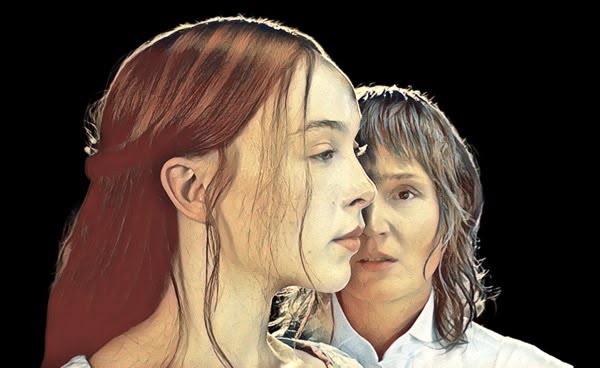
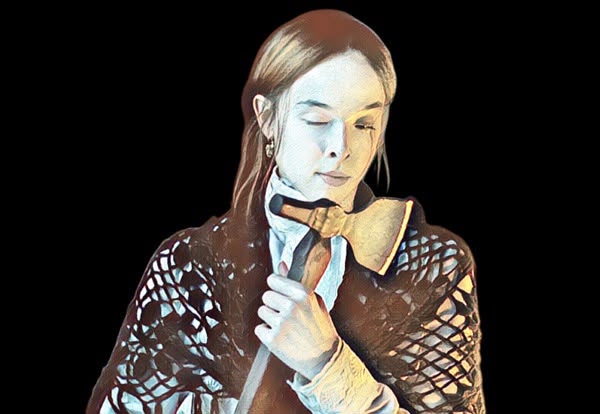
Beatty manages to sustain the leading role. She has presence, a face suited to Lizzie’s strangeness, and finds some effectiveness in the character’s initial passivity. The problem is that she is not yet capable of providing all the dramatic complexity the role demands.
Related to this: What the Series Got Right and Everything It Made Up
Her Lizzie remains confined to a small range of expressions: wide eyes, a low and breathy voice, a slightly open mouth, and a kind of permanent bewilderment. Beatty must convince us of the transformation from infantilized woman to lover, conspirator, possible murderer, criminal celebrity, and older figure haunted by her own mythology. The transformation happens in the script and makeup, but rarely within the performance.
She holds the center. She does not create enough nuance to fill it. Once again, critics described her performance as an “inscrutable blankness” that works while everyone around her operates several decibels above normal, but they also observed that Vicky Krieps is far more interesting. Others were more direct, saying that Beatty moves through the series with essentially one expression. There is talent there, but also a very young actress being handed a role that demands decades of emotional experience. She does not damage the series. Nor does she manage to dominate it.
Rebecca Hall, Vicky Krieps, and Everyone Else’s Different Register
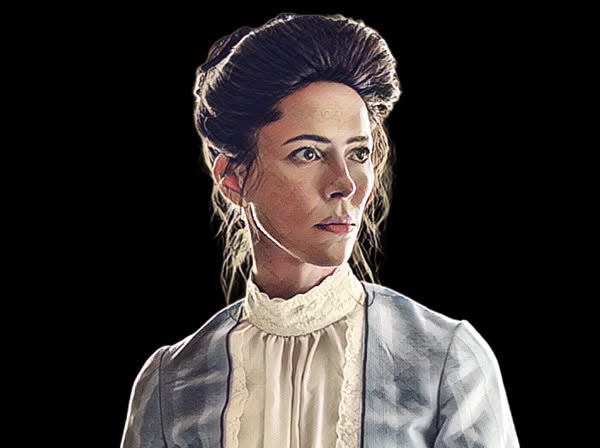
Rebecca Hall is spectacular. Her Abby is unbearable, cruel, funny, and pathetic, without ever failing to reveal a woman trapped inside the same domestic structure. Hall understands that there is no way to survive such heightened material by pursuing naturalism. She embraces the excess and turns every line into a small act of aggression.
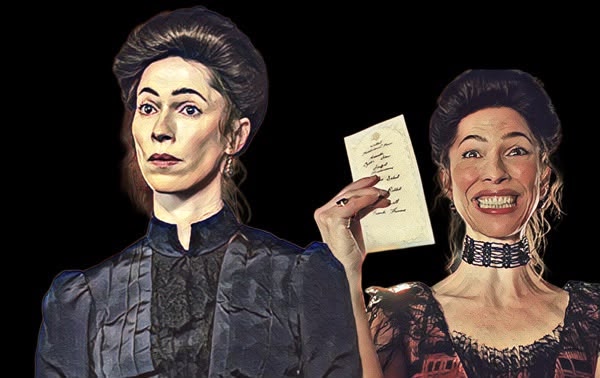
TheWrap called her the true scene-stealer and observed that she plays the most ridiculous material as if it were Shakespeare. That is exactly right. Hall overacts, but she knows why she is doing it.
Vicky Krieps delivers the season’s most mysterious performance. Her Bridget seems to have arrived from another film, and perhaps that is precisely what makes her so interesting. She carries the air of a character from a European novel, someone who has already lived far more than anyone else in that house. Even when the script turns Bridget into a collection of conveniences — lover, sexual mentor, poisoner, Báthory storyteller, and accomplice — Krieps preserves something inaccessible.
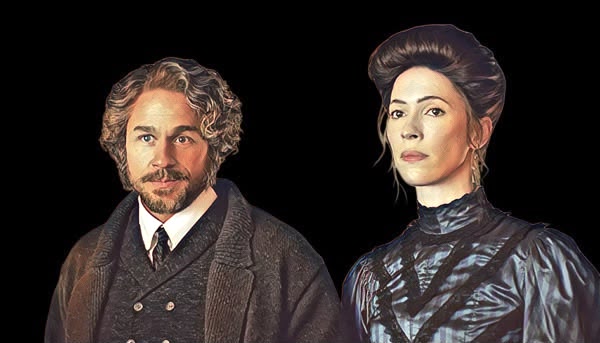
The lack of unity weighs on the rest of the cast. Some actors commit to camp; others attempt period drama. Some deliver caricatures, while others feel entirely sanitized. Charlie Hunnam plays Andrew at such a heightened register that the character arrives fully formed as a villain, without contradiction. Jessica Barden understands Nance O’Neil’s theatricality, but she is playing a figure whom the script has displaced in time simply to solve the trial.
They do not seem to be acting in the same series. At times, they do not even seem to be acting in the same genre.
The Strange Disappearance of the Songs
The early musical choices suggest that the season will embrace a pop, anachronistic reading of the case. Kate Bush, the Runaways, Wet Leg, Fiona Apple, Taylor Swift, and “Bitter Sweet Symphony” invade the nineteenth century to remind us that this is not a respectful historical reconstruction.
Some choices work. Others underline with a fluorescent marker what the image has already explained. The inclusion of Lambrini Girls’ “Cuntology 101” during the Bordens’ poisoning is so unsubtle that it practically becomes a joke.
My problem is that this musical strategy disappears and reappears without logic. The series begins like a Gothic music video, abandons that energy for long stretches, then recovers the songs whenever it needs to manufacture momentum. Instead of creating unity, the soundtrack exposes the instability of the narrative.
It is as if each block had been conceived for a different series: Victorian romance, Gothic horror, sexual melodrama, courtroom drama, camp satire, feminist manifesto, and an unsolicited Aileen Wuornos special.
Ryan Murphy Being Ryan Murphy
It is still too soon to gauge what everyone thought of a series released on September 17, but it does not appear that the Monster franchise is managing to rise above the many true-crime productions already available. Even so, I respect Ryan Murphy because his ambition remains visible even when he loses control. There are unforgettable images, great actresses, macabre humor, and an aesthetic nerve missing from many supposedly more sophisticated productions.
The problem is that excess is not a substitute for depth. Anachronism is not analysis. And turning every violent woman into a link in the same chain of female rage may seem daring, but it also reduces completely different stories to one convenient explanation.
Monster begins by asking who killed Andrew and Abby Borden. It ends by answering a different question: What would happen if Lizzie were transformed into the patron saint of female rage?
The answer is lavish, bloody, sexually charged, and often entertaining. It is simply not quite the story of Lizzie Borden. Fantasy solves the crime. The mystery was more interesting.
Descubra mais sobre
Assine para receber nossas notícias mais recentes por e-mail.

